
Cap Rates Explained: What Every Investor Should Know in 2026
Published November 2026 | Awesome ROI Market Insights
Cap rates are the single number that shapes almost every commercial property price. In fact, when brokers, lenders, and investors talk about whether a deal is cheap or expensive, they are usually talking about this number. In the first half of 2026, average cap rates across U.S. property types held roughly flat near 6.6%, according to CBRE’s U.S. Cap Rate Survey as reported by CRE Daily. So, what is a cap rate, and how should investors use it? Here is a simple guide.
What Are Cap Rates?
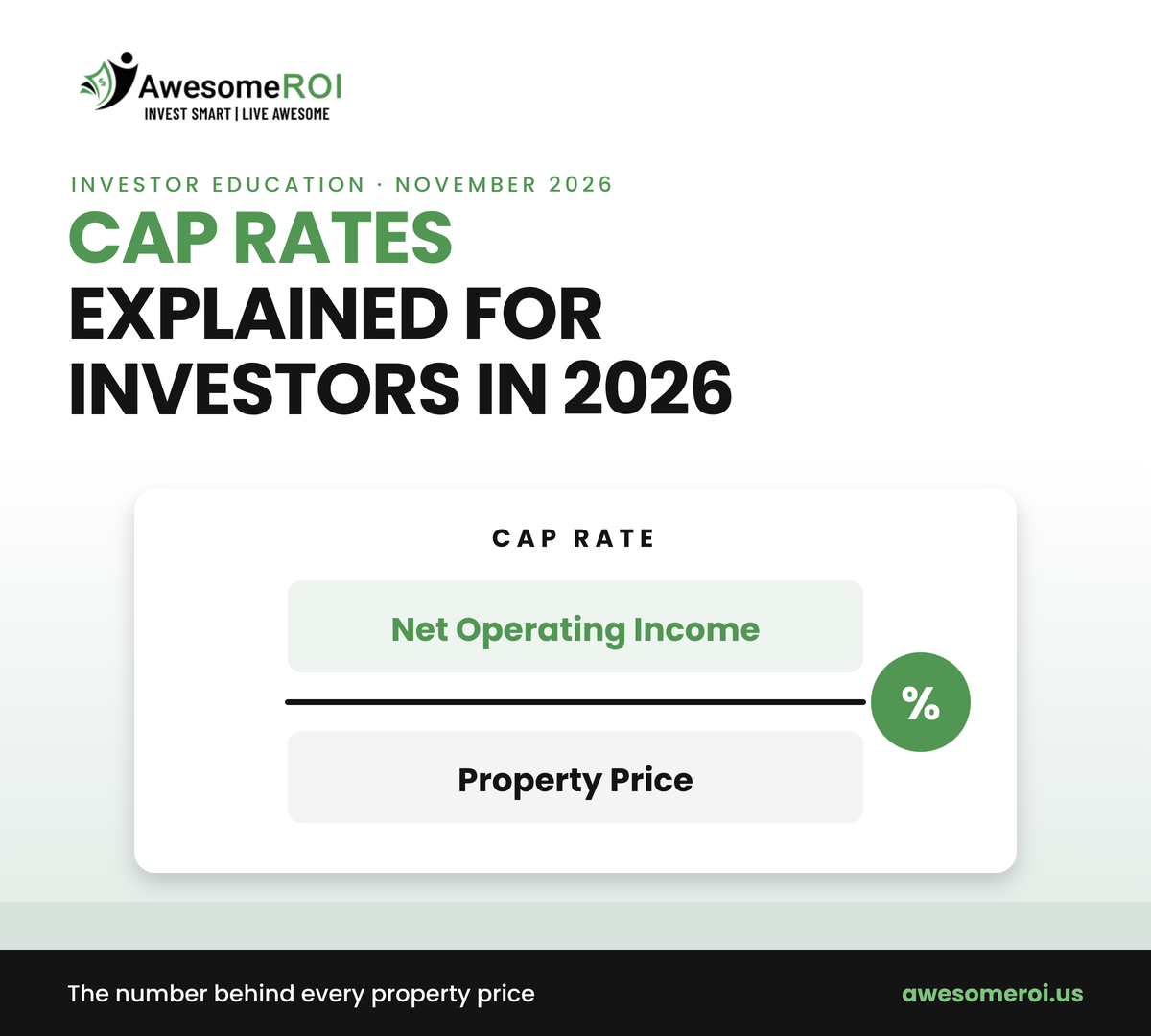
A capitalization rate, or cap rate, is a property’s net operating income divided by its price, as defined by Nareit. Net operating income is the rent a property collects minus its operating costs, before any loan payments. For example, if a building earns $100,000 a year in net operating income and sells for $1,500,000, its cap rate is about 6.7%.
In other words, the cap rate tells you the yearly return you would earn if you bought the property with all cash. Because it ignores debt, it lets you compare properties on equal terms.
Why Cap Rates and Prices Move in Opposite Directions
This is the part that confuses many new investors. When cap rates go up, prices go down. Likewise, when they go down, prices go up. Here is why. Using the same $100,000 of income, a 6% cap rate means a price of about $1,670,000. However, an 8% cap rate means a price of only $1,250,000. As a result, even a small change in this rate can move a property’s value by a lot.
How Interest Rates Affect Cap Rates
These rates usually follow interest rates over time, especially the 10 year Treasury yield. That is because investors compare property returns with what they could earn from safer bonds. Recently, the 10 year Treasury yield was 5.13% on November 16, 2026, per Trading Economics. Meanwhile, CBRE’s survey respondents said the 10 year yield would need to fall to about 3.75% before sales activity picks up meaningfully. In short, higher rates put upward pressure on property yields, which can create better entry prices for buyers.
Cap Rates in Phoenix Today
Local numbers matter more than national averages. For example, Phoenix retail cap rates averaged 6.64% in the third quarter of 2026, according to Matthews. At the same time, retail vacancy was just 4.6%, and average asking rent hit a record $27.19 per square foot. In addition, CBRE noted that neighborhood retail saw the largest cap rate decline nationally in the first half of the year. Together, these figures suggest strong demand for well located retail.
What Cap Rates Do Not Tell You
This number is a starting point, not the full story. First, a cap rate is a snapshot of one year of income, so it does not show future rent growth. Second, it ignores financing, which can raise or lower your actual return. Third, a high cap rate can signal higher risk, such as weak tenants or a short lease. Therefore, smart investors pair it with other measures like IRR and cash on cash return. You can learn more in our guide to real estate deal metrics.
How Awesome ROI Uses Cap Rates
At Awesome ROI, we look at the cap rate when we buy and the cap rate we expect when we sell. Then, we focus on raising net operating income through leasing and better operations. Because value equals income divided by the cap rate, every dollar of added income can increase a property’s value. Explore our current offerings to see this approach at work.
Cap rates measure yield. They equal net operating income divided by price.
Prices move the other way. Higher cap rates mean lower prices, and the reverse.
Interest rates matter. A higher 10 year Treasury yield tends to push them up.
Income growth creates value. Raising net operating income can lift a property’s value.
Ways to Get Started
Try different yields and income levels with our free IRR calculator. You can also invest through a 401(k) or Self Directed IRA. Then, book a free investment strategy call.
Frequently Asked Questions About Cap Rates
What is a good cap rate? It depends on the property type, location, and risk. A lower cap rate often means a safer, more in demand property, while a higher cap rate may offer more yield with more risk.
How do you calculate cap rates? Simply divide a property’s yearly net operating income by its price or value.
Why do cap rates rise when interest rates rise? Investors want property returns to stay attractive compared with bonds. So, when bond yields rise, buyers usually expect higher yields from property.
This article is for educational purposes only and is not investment advice.
Talk to Awesome ROI
Understanding this one number helps you spot real value. To talk through any deal, schedule a call with our team, contact us, or call +1 (833) 652 7103.

Recent Posts

Why California Investors Are Choosing Arizona Real Estate
Step Up in Basis: How Real Estate Builds Generational Wealth