

2026 CRE Market Update: What Investors Need to Know Now
Published August 2026 | Awesome ROI Market Insights
This commercial real estate market update 2026 covers what moved the market in the second quarter. Investment volume grew for a third straight quarter. Industrial and hospitality led the way. Senior housing kept outperforming, too, thanks to a historic demographic wave. Below, Awesome ROI breaks down the numbers. We also explain what they mean for your next move.
Commercial Real Estate Market Update 2026: Investment Volume Rises 9%
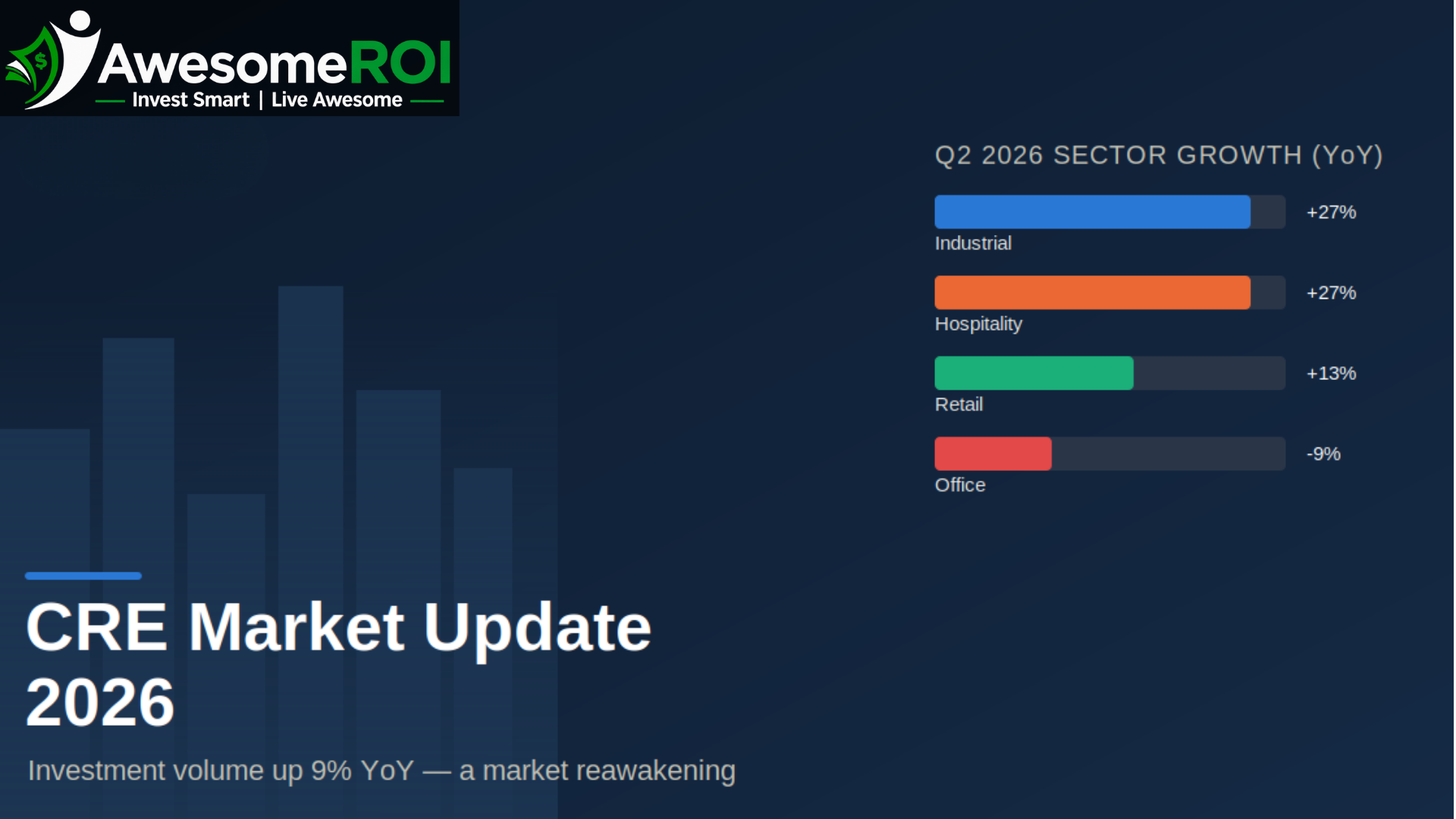
U.S. commercial real estate investment volume hit $113.7 billion in Q2 2026. That is up 9% year over year, based on MSCI Real Capital Analytics data. It marks the third straight quarter of strong gains. In short, the market keeps recovering from the 2023 to 2024 downturn.
One clear driver stood out this quarter. Large, entity level “take private” deals came back for the first time in two years. These included Veris Residential, ECHO Realty, and Peakstone Realty Trust. Deals like these often signal something bigger. They show that large investors trust today’s pricing again. As a result, more big money may follow. If you are weighing when to rebalance your own commercial real estate portfolio, this kind of activity is worth watching closely.
Sector Performance: Industrial and Hospitality Lead the Recovery
Industrial Real Estate Investment Climbs 27%
Industrial stayed one of the busiest sectors in Q2 2026. It posted $32.5 billion in transaction volume. That is up 27% year over year. In fact, this marks a fourth straight quarter of double digit growth for individual asset sales. Portfolio and entity level industrial deals rose 33% as well.
Hospitality Investment Also Up 27%
Hotel investment rose 27% year over year to $8 billion. That extends a three quarter streak of steady growth. Full service hotels led the gains, up 80%. This is a reversal from 2025, when limited service hotels led instead.
Retail Investment Rises 13%
Retail transaction volume reached $18 billion. That is up 13% year over year. However, one large deal drove much of that gain. Without it, retail growth would look closer to Q1’s pace.
Multifamily Holds Roughly Flat
Multifamily investment totaled $36.7 billion. That is close to flat year over year. Garden apartment sales fell 21%, though. Meanwhile, mid rise and high rise properties picked up some of the slack.
Office Market Stabilizes Despite a Soft Quarter
Office investment dipped 9% year over year in Q2. A weak May drove most of that dip. Even so, first half 2026 volume is still up 14% from last year. On top of that, prime office vacancy fell to 12.7% nationally. Demand for top tier space keeps rising, even as older buildings struggle.
Strong Fundamentals Are Driving the 2026 CRE Recovery
Several forces are fueling this quarter’s growth. Here is what stands out:
- Global capital is moving faster. Direct investment rose 28% year over year worldwide. The Americas grew 26%, EMEA grew 27%, and Asia Pacific had its busiest Q2 in five years, up 38%.
- Debt markets are loosening up. Banks are easing lending rules as borrower demand grows. As a result, refinancing and new deals are easier to fund.
- The Fed still has room to cut rates. The Federal Reserve has cut rates three times since mid 2025. That brought the federal funds rate down to a range of 3.5% to 3.75%. One more cut is possible later in 2026.
- Supply is historically tight. New construction is limited across industrial, senior housing, and prime office space. Because of this, vacancy stays low and pricing power stays strong for well located assets.
Senior Housing Investment: The Standout Sector of 2026
Senior housing remains one of the strongest stories in this year’s commercial real estate market. National occupancy hit 89.9% in Q2 2026. That marks a 20th straight quarter of gains. In fact, half of the sector’s 31 primary markets now sit above 90% occupancy.
Trailing 12 month investment sales reached $33.3 billion through May 2026. That is an 83% jump year over year. Price per unit climbed too, up 29% to $182,800. Meanwhile, cap rates compressed toward 6.2%.
The timing lines up with a major shift. The first wave of baby boomers turns 80 in 2026. That is the age when a move to senior housing often becomes urgent. On top of that, new supply sits at its tightest point since tracking began in 2006. Inventory grew just 0.4% year over year in Q2. If senior housing is new territory for your portfolio, our team can walk you through how we underwrite these deals.
2026 CRE Market Outlook: What to Expect for the Rest of the Year
Investment momentum should keep building through the rest of 2026. However, year over year comparisons will get tougher. That is because the recovery is now measuring itself against its own strong gains from earlier this year. Pricing tells a more mixed story. The all property price index is up just 0.9%. Cap rates have also drifted slightly higher in some sectors. In short, the recovery is broadening, but it is still uneven across property types. If the Fed delivers one more rate cut, it would likely support further cap rate stability and deal activity heading into 2027.
Key Takeaways from This Commercial Real Estate Market Update
- Favor sectors with the clearest supply and demand gap. Industrial, hospitality, and senior housing all pair tight supply with rising demand.
- Watch office selectively. Suburban and prime office space is recovering faster than older, commodity buildings. In fact, first half volume trends look better than the Q2 headline number suggests.
- Track Fed policy and bank lending closely. Easier credit is already showing up in stronger debt originations and refinancing activity.
- Consider senior housing for the long term. The “80 and up” demographic wave, paired with a two decade supply drought, makes this one of the more durable stories in commercial real estate today.
- Underwrite carefully. Strong volume growth does not always mean strong pricing. So, discipline still matters more than headline numbers.
Frequently Asked Questions About the 2026 CRE Market
Is commercial real estate recovering in 2026? Yes. U.S. CRE investment volume rose 9% year over year in Q2 2026. That marks the third straight quarter of strong growth, according to MSCI Real Capital Analytics.
Which CRE sector is performing best in 2026? Industrial and hospitality each grew 27% year over year in Q2 2026. Senior housing did even better, with an 83% jump in trailing 12 month investment sales.
Is now a good time to invest in senior housing? Senior housing occupancy hit a 20 year high of 89.9% in Q2 2026. That happened alongside record tight supply and a wave of baby boomers turning 80. Many investors see this as a strong long term entry point. Still, results vary by market, so local research matters.
What’s Next for Your Commercial Real Estate Portfolio?
That wraps this commercial real estate market update 2026. The second half of the year looks set to build on this momentum. Whether you want to expand your portfolio, shift toward stronger sectors like senior housing and industrial, or explore how easier credit could open new deals, Awesome ROI is here to help every step of the way.
Talk to Awesome ROI about your next CRE investment
Sources:
- MSCI Q2 2026: Entity Deals Lift Volume as Sector Recoveries Diverge (Colliers Knowledge Leader)
- Seniors Housing 2026: Occupancy Hits 20-Year High at 89.9% (HB Capital)
- Senior Housing Occupancy Hits 20th Consecutive Quarter Gain (NIC via LinkedIn)
- Global Real Estate Perspective, August 2026 (JLL)
- U.S. Office Market Dynamics, Q2 2026 (JLL)
- Continued Prime Space Recovery Augurs Well for the Rest of the Office Market (CBRE)
- The Outlook for Another Fed Rate Cut in January (RSM US)

Recent Posts

Why Branded Hotel Investing Is Making a Comeback in Arizona
Why Phoenix Flex Warehouse Space Is in High Demand