

Step Up in Basis: How Real Estate Builds Generational Wealth
Published November 2026 | Awesome ROI Market Insights
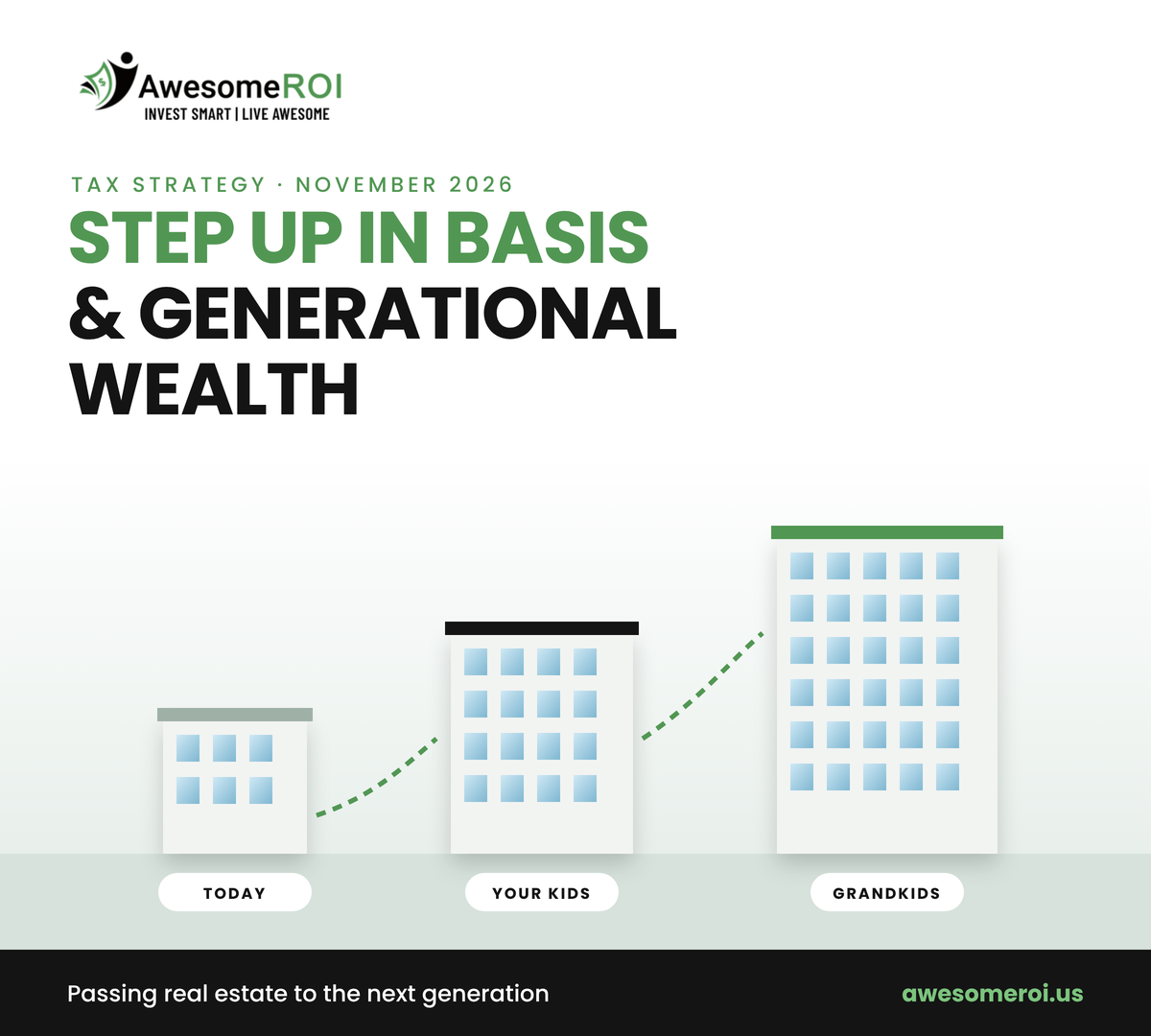
The step up in basis is one of the most powerful and least understood ways real estate builds generational wealth. In simple terms, when someone inherits property, its tax basis is generally reset to its market value at the date of death, according to the IRS. As a result, years of built up gains may never be taxed. In addition, the federal estate tax exemption is now $15 million per person in 2026 and rises to $15.48 million in 2027. So, how can investors use these rules to pass on more to their families? Here is a clear guide.
What Is a Step Up in Basis?
In general, your basis is roughly what you paid for an asset, adjusted over time. For example, depreciation lowers the basis of a property each year. When you sell, you generally pay tax on the difference between the sale price and your basis. However, when an heir inherits the property, the basis usually steps up to its fair market value on the date of death.
For example, here is a simple scenario. Suppose a parent bought a building for $1 million, and it is worth $3 million when they pass away. Normally, a sale would trigger tax on a large gain. But with a step up in basis, the heir’s basis becomes $3 million. Therefore, if the heir sells soon after for $3 million, there may be little or no capital gains tax. This example is simplified and for illustration only.
Why Real Estate Works So Well With a Step Up in Basis
In fact, real estate offers a unique combination of benefits. First, depreciation can reduce taxes on income while you own the property. Second, a 1031 exchange can defer capital gains when you sell and buy another property. Third, the step up in basis at death can reset the basis for your heirs.
Investors sometimes call this approach “swap till you drop.” In other words, you keep exchanging into new properties, deferring taxes along the way, and your heirs may receive the property at its stepped up value. As JTC explains, this can erase deferred gains built up across many exchanges.
The Estate Tax Exemption in 2026 and 2027
The 2025 tax law set the federal estate and gift tax exemption at $15 million per person starting in 2026, or $30 million for a married couple, and made it permanent with yearly inflation adjustments, according to Morgan Lewis. Then, in November 2026, the IRS raised the exemption to $15.48 million for 2027. In addition, the annual gift exclusion rises from $19,000 in 2026 to $20,000 per recipient in 2027. Meanwhile, Arizona repealed its state estate tax years ago, according to the Arizona Legislature.
Step Up in Basis Planning Tips for Investors
Keep good records. First, track what you paid, improvements, and depreciation, so your heirs and advisors have a clear picture.
Think about how you hold property. Ownership through trusts, LLCs, or partnerships can affect how basis rules apply. So, review your structure with an estate attorney.
Use annual gifts wisely. Gifting interests during life can reduce your estate. However, gifted property usually keeps your original basis instead of stepping up.
Watch for law changes. Proposals to limit the step up in basis have been introduced in Congress before. Although none has passed, tax laws can change.
How Awesome ROI Fits Into a Legacy Plan
In addition, many of our investors think beyond their own retirement. For example, they want real assets their children can inherit, with income along the way. Awesome ROI offers investments in Arizona retail centers, flex warehouses, and RV and boat storage that our in house team operates. Explore our current offerings to learn more.
Basis resets at death. In short, heirs generally receive property at its fair market value.
Gains can disappear. As a result, built up appreciation may never be taxed as capital gains.
The exemption is high. It is $15 million per person in 2026 and $15.48 million in 2027.
Plan with professionals. Above all, ownership structure and gifting choices affect the result.
Ways to Get Started
Model long term growth with our free IRR calculator. You can also invest through a 401(k) or Self Directed IRA, though retirement accounts follow different inheritance rules. Then, book a free investment strategy call.
Frequently Asked Questions About the Step Up in Basis
What does step up in basis mean? In short, it means that when you inherit property, your tax basis is generally reset to its fair market value on the date the owner died.
Does a step up in basis apply to gifts? Generally, no. Property given during life usually keeps the giver’s original basis, while inherited property usually gets the step up.
Does Arizona have an estate tax? No. Arizona repealed its estate tax, although the federal estate tax still applies to estates above the exemption.
This article is for educational purposes only and is not tax or legal advice. Please consult a qualified tax professional and estate attorney about your situation.
Talk to Awesome ROI
In the end, real estate can support your family for generations. To talk about your goals, schedule a call with our team, contact us, or call +1 (833) 652 7103.

Recent Posts

Why California Investors Are Choosing Arizona Real Estate

Step Up in Basis: How Real Estate Builds Generational Wealth