
Value Add Real Estate: How Investors Create Value in 2026
Published November 2026 | Awesome ROI Market Insights
Value add real estate is the strategy many investors favor in 2026. In fact, value add funds captured 37% of all real estate capital raised in 2026 through the third quarter, the largest share of any strategy, according to PERE data reported by CRE Daily. Similarly, CBRE found that value add and core plus were the top choices for two thirds of investors this year. So, what does value add actually mean, and how is value created? Here is a plain English guide.
The Four Real Estate Strategies
In general, investors group real estate into four strategies, from lowest to highest risk.
Core. Stable, fully leased properties with little debt. For example, core funds in the NFI ODCE index must be at least 75% leased and use no more than 35% debt, per PREA Quarterly.
Core plus. Mostly stable properties with some room to improve.
Value add. Properties with a clear problem to fix, such as vacancy, below market rents, or dated buildings.
Opportunistic. The highest risk, often new development or major repositioning.
In other words, value add sits in the middle. It offers more upside than core, but with less risk than ground up development.
How Value Add Real Estate Creates Value
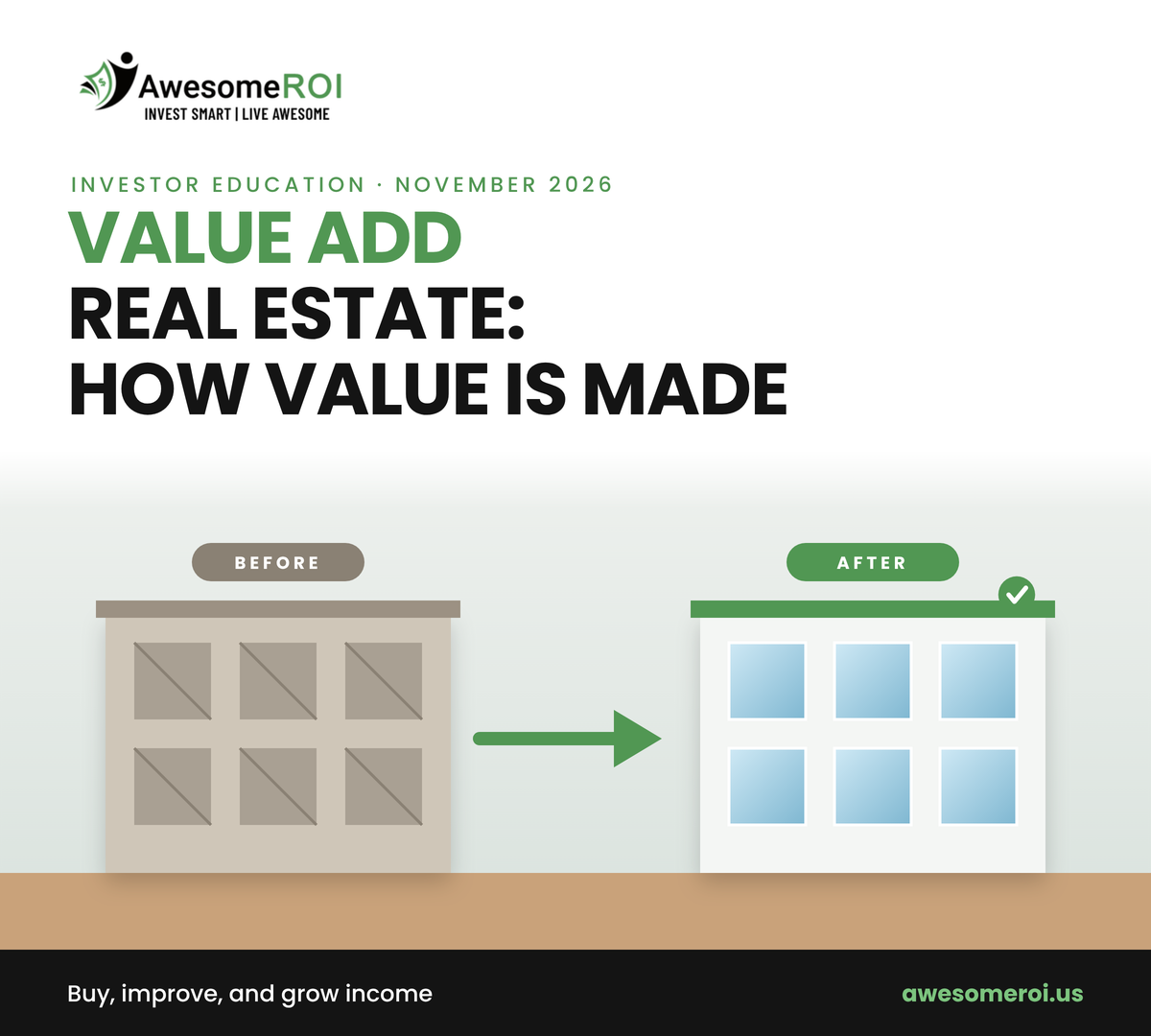
Overall, the idea is simple. First, buy a property that is underperforming. Next, fix what is holding it back. Then, the higher income supports a higher value. Common value add levers include:
Leasing vacant space. As a result, filling empty units adds income right away.
Bringing rents to market. As older leases expire, rents can reset to current levels.
Renovating. Updated storefronts, signs, lighting, and parking can attract better tenants.
Improving operations. Better management can lower costs and reduce turnover.
Re tenanting. Replacing weak tenants with stronger ones can raise both income and value.
Because property value is roughly income divided by the cap rate, each added dollar of net operating income can lift value by much more. You can learn more in our guide to cap rates.
What the Returns Data Shows
Of course, returns vary with the market cycle. For instance, over the 10 years through mid 2025, value add strategies returned about 7.1% a year, compared with 5.7% for core, according to PREA Quarterly. However, over the prior three years, value add returns were negative, as higher rates hit property values. In short, value add can outperform over time, but timing and execution matter.
The Risks of Value Add Real Estate
However, value add carries real risk. First, renovations can cost more and take longer than planned, especially with building costs rising. Second, leasing up vacant space may take longer than expected. Third, higher interest rates can squeeze returns, particularly with floating rate debt. Finally, the business plan depends on the operator’s skill. Therefore, the sponsor’s track record matters more in value add than in almost any other strategy.
How Awesome ROI Applies Value Add
Value add is at the heart of how we invest. Specifically, we look for Arizona properties with a clear, fixable gap. Then, our in house team of about 72 people handles leasing, renovations, and operations directly. For example, at our Avondale laundromat project, now called Awesome Spin and Sip, we are adding a drive through café and laundry pickup to create new income streams. Explore our current offerings to see more.
Value add is in demand. In fact, it captured the largest share of real estate fundraising in 2026.
The plan is simple. In short, buy, improve, and grow income.
Income drives value. In turn, higher net operating income can raise property value.
Execution is everything. Ultimately, the operator’s skill decides the outcome.
Ways to Get Started
See how rising income changes returns with our free IRR calculator. You can also invest through a 401(k) or Self Directed IRA. Then, book a free investment strategy call.
Frequently Asked Questions About Value Add Real Estate
What is value add real estate? It is a strategy of buying underperforming properties and improving them through leasing, renovation, or better management to increase income and value.
Is value add riskier than core? Yes. Value add involves more uncertainty because returns depend on carrying out a business plan. In return, it offers more potential upside.
How long do value add deals usually last? It depends on the plan. For example, many take several years to complete improvements and stabilize income before a sale or refinance.
This article is for educational purposes only and is not investment advice.
Talk to Awesome ROI
In the end, we build value by running properties better. To learn how, schedule a call with our team, contact us, or call +1 (833) 652 7103.

Recent Posts

Why California Investors Are Choosing Arizona Real Estate

Step Up in Basis: How Real Estate Builds Generational Wealth