

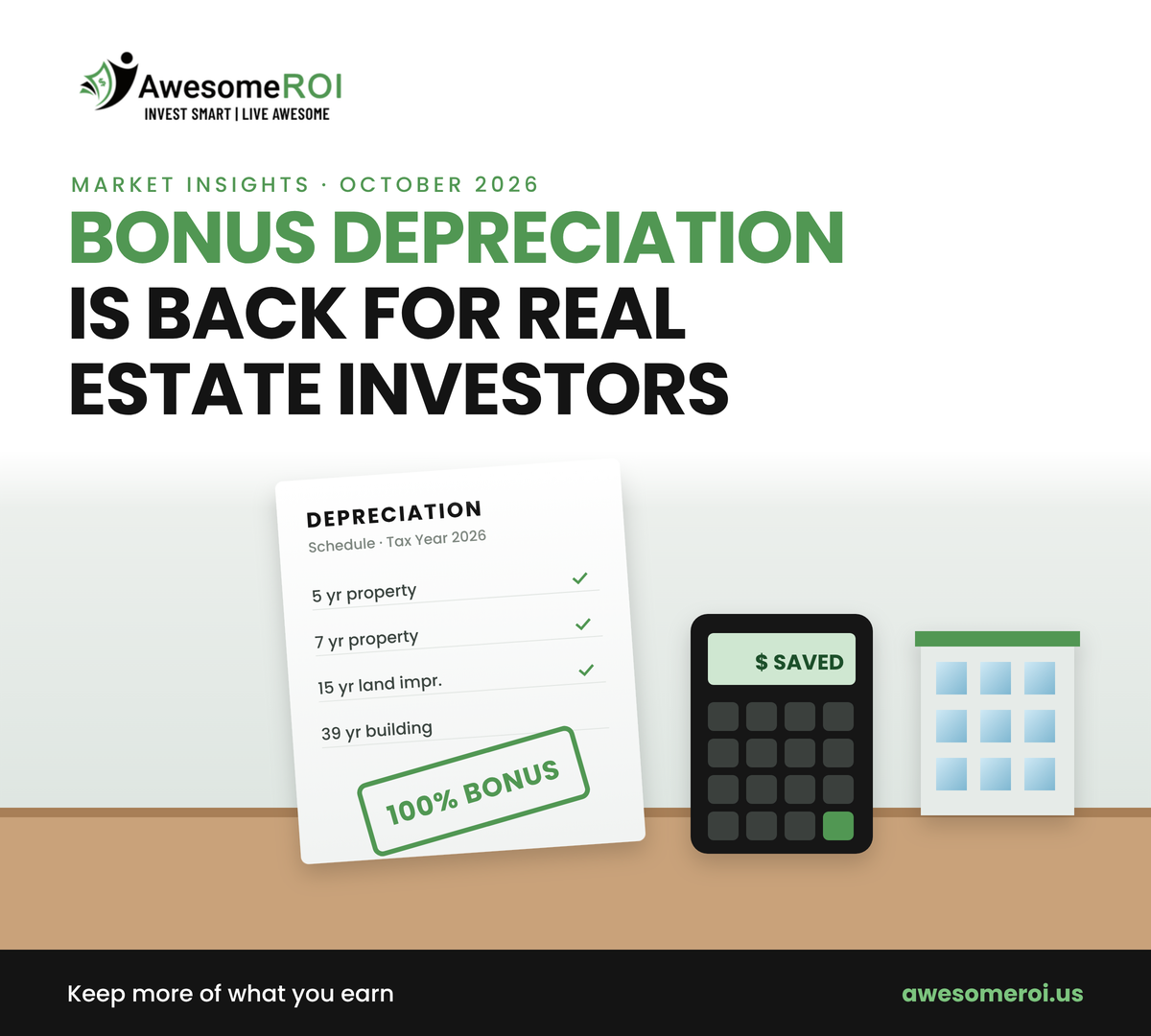
Bonus Depreciation Is Back: How Investors Can Lower Their Tax Bill With Real Estate
Published October 2026 | Awesome ROI Market Insights
Bonus depreciation for real estate investors is back, and this time it is permanent. The One Big Beautiful Bill Act, signed on July 4, 2025, restored 100% bonus depreciation for qualified property acquired after January 19, 2025. The IRS issued guidance on the change in January 2026, as explained in IRS News Release IR-2026-06. As a result, investors who own commercial real estate can get larger deductions much sooner. So, here is how it works in plain English.
What Depreciation Does for Real Estate Investors
First, the tax code assumes buildings wear out over time. So, owners can deduct part of a building’s cost every year, even if the property is rising in value. In particular, commercial buildings are normally deducted over 39 years. In other words, that is slow. However, not every part of a property lasts 39 years. For example, parking lots, landscaping, lighting, and certain equipment wear out much faster. Therefore, those items can qualify for shorter schedules of 5, 7, or 15 years.
How Cost Segregation and Bonus Depreciation Work Together
Specifically, a cost segregation study is an engineering review that separates a property into its parts. The IRS Cost Segregation Audit Techniques Guide explains what a quality study includes. Once the shorter life items are identified, 100% bonus depreciation allows those costs to be deducted in the first year. As a result, an owner can move years of deductions into year one. In turn, that can free up cash that would otherwise go to taxes.
A Simple Example
Here is a simplified, hypothetical example. Imagine a group of investors buys a $2,000,000 commercial property. First, a cost segregation study finds that $400,000 of the cost is parking, lighting, and equipment with shorter lives. Next, with bonus depreciation, that $400,000 may be deducted in the first year instead of over many years.
Meanwhile, the rest of the building is still deducted over 39 years. As a result, investors could see a large paper loss in year one, even while the property pays cash distributions. Of course, real results depend on the property, the study, and each investor’s tax situation.
How Investors in a Syndication Benefit
In practice, when you invest in a real estate syndication, you usually own an interest in a partnership or LLC. Depreciation flows through to investors on a Schedule K-1. So, passive investors may receive paper losses that offset the income from the deal. However, there are rules. Passive losses generally can only offset passive income, and the special $25,000 rental allowance phases out at higher incomes, per IRS Publication 925. Because every situation is different, always review your plans with a qualified tax advisor.
Why This Matters for Awesome ROI Investors
Awesome ROI invests in operating properties like retail centers, flex warehouses, storage, and service businesses. Many of these assets include site work, equipment, and improvements that may qualify for faster depreciation. In addition, the law made the 20% qualified business income deduction permanent. Together, these changes make direct ownership of real estate more tax efficient than many paper assets. Explore our current offerings to see the types of properties we own.
100% bonus depreciation is permanent. It applies to qualified property acquired after January 19, 2025.
Cost segregation unlocks it. An engineering study identifies parts of a property that qualify for faster write offs.
Benefits flow to investors. In a syndication, depreciation passes through to partners on a K-1.
Rules still apply. Passive loss limits matter, so work with a tax professional.
Ways to Get Started
Compare after tax scenarios on a sample deal with our free IRR calculator. If you plan to sell an appreciated property, a 1031 exchange may let you defer the gain. You can also invest through a 401(k) or Self-Directed IRA. Then, book a free investment strategy call.
Frequently Asked Questions About Bonus Depreciation
Is 100% bonus depreciation permanent? Yes. The One Big Beautiful Bill Act made 100% bonus depreciation permanent for qualified property acquired after January 19, 2025.
Can passive investors use bonus depreciation? Investors in a partnership can receive their share of depreciation on a K-1. How much they can use depends on passive loss rules and their tax situation.
Do I need a cost segregation study? A cost segregation study is typically how owners identify property that qualifies for shorter depreciation lives and bonus depreciation.
This article is for educational purposes only and is not tax advice. Please consult a qualified tax professional about your situation.
Talk to Awesome ROI About Tax Efficient Investing
In the end, real estate can do more than produce income. It can also help you keep more of it. To learn how our investments are structured, schedule a call with our team, contact us, or call +1 (833) 652-7103.

Recent Posts

Accredited Investor Guide 2026: Who Qualifies and What Deals It Unlocks

The AI Data Center Boom in Phoenix: What It Means for Real Estate Investors